
The Family Investment Company: Benefits and Risks (Avoid These 3 Mistakes)
Family investment companies (FICs) are becoming increasingly common among high-net-worth families. An FIC is typically a family-held LLC or family limited partnership (FLP) in which a wealthy founder transfers assets into the company, and other family members become partners or members in the business.
Creating an FIC can be a good way to protect and manage assets, pass on wealth to future generations, and reduce tax liabilities. However, over the years the IRS has cottoned on to the fact that some FICs exist for the sole purpose of reducing or avoiding taxes. This has led to increased scrutiny.
If you have an FIC, or are thinking about creating one for your family, here’s what you should know.
You Need a Legitimate Non-Tax Reason to Operate a Family Investment Company
The purpose of the FIC cannot be to reduce or avoid taxes. There must be a legitimate non-tax reason for the family investment company to exist in the first place.
For many families, centralized asset management is reason enough. FICs allow for assets to be pooled, managed, and overseen by multiple family members, rather than keeping those assets in separate trusts or an individual’s account(s).
Other potential legitimate reasons for creating and maintaining an FIC include:
- Asset protection (from creditors, family members, impending divorce, etc.)
- Business succession planning
- Preservation of larger assets by avoiding fractionalization
These are just some of the possible legitimate reasons to have an FIC; discuss your unique situation with your tax preparer, wealth advisor, business attorney, and/or estate planning attorney.
If the IRS determines that the FIC exists solely to evade paying taxes, it may be able to disregard the transfer of certain assets under Internal Revenue Code Section 2036 and count them in the estate of the donor/founder at death – a bigger topic we may cover in the future. For now, just remember that an FIC must have a non-tax purpose for existing.
You Must Respect the Business Entity and the Business
The IRS may look to see if the company is being run like a company or if it’s only “on paper.” A business that’s just on paper will have little to no activity and may serve solely as a place for assets to sit and generate income passively.
In contrast, a legitimate business in the eyes of the IRS is one that has a clear structure, maintains formalities such as holding meetings and keeping minutes, and engages in substantial economic activity such as managing and investing assets.
In addition, members/partners must respect the business entity itself and avoid piercing the corporate veil (read more about this on our blog).
Watch Out for Fractional Gifts
Why did the IRS start looking at family investment companies more closely over the past decade or so? Because some people got a little too greedy. Here’s what happened.
High-net-worth individuals discovered that the use of fractional gifts was a good way to handle the logistics of passing on assets to future generations, and it provided a tax benefit, too. A fractional gift in the context of an FIC typically involves a founder transferring a partial ownership interest in the FIC to a family member who is also a member/partner of the FIC.
This partial interest is eligible for discounts, often a discount for lack of control (when the stake in the business is under 50%) and a discount for marketability (because it’s harder to find buyers for a smaller, non-controlling share of a business). These discounts lower its value and, consequently, reduce the amount of gift taxes the donor is liable for. (Read more about discounts and on valuation of closely held companies here on our blog.)
But pigs get fat, hogs get slaughtered, as we often say. Not too long ago, some people tried to push the limit on these discounts, reducing the value beyond what the IRS found reasonable. This is what led to the IRS cracking down on families using FICs and fractional gifts, in particular, as tax evasion tools.
What’s a reasonable discount? There is no set number. This is something that needs to be determined on a case-by-case basis, ideally with the advice of an attorney, tax professional, and/or financial advisor.
Legal Advice on Business Matters and Estate Planning
For help with short-term and long-term estate planning and business planning, including succession planning, speak with Gem McDowell. Gem and his team help individuals and business professionals protect their interests and plan for the future with customized estate plans, corporate governance documents, and strategic advice. Gem also has many years of experience in tax law and holds a master’s degree in tax law from Emory University, and he is ready to help advise you on your tax issues.
Call the Gem McDowell Law Group, with offices in Myrtle Beach and Mt. Pleasant, SC, today at 843-284-1021 to schedule your free consultation.

Doing Good While Making Money: Benefit Corporations in South Carolina
You’ve heard of C-corps and S-corps, but what about B Corps?
B Corp is short for benefit corporation, a type of for-profit business entity that is regulated by state law. Currently, 35 states and DC have enacted legislation to create benefit corporations, including South Carolina.
As stated in the 2012 South Carolina Benefit Corporation Act (find it here), “a benefit corporation shall have as one of its corporate purposes the creation of a general public benefit.” Here, “general public benefit” is defined as “a material positive impact on society and the environment taken as a whole.”
Who Benefits from a Benefit Corporation?
Traditionally, corporations are run with the primary driver of making money for their shareholders. High-level decisions are made with this question in mind: How can we maximize profits for the benefit of the shareholders? Though it’s not actually a legal requirement for corporations to make the most money possible, this is often the way it works in the real world. After all, a CEO who doesn’t make enough money for the shareholders can be ousted by the board of directors.
But in a B Corp, making money is not the primary driving force. Instead, business decisions are guided, in part, by the desire to create a particular benefit in the world.
Examples of some benefits that a B Corp might have include:
- Donating a portion of income to charitable causes
- Operating in a way to reduce environmental impact or actively preserve the environment
- Providing goods and services to a specific group of people such as low-income families
- Providing employment and economic opportunities for underserved groups
- Promoting education or awareness of a certain subject
- Advancing the welfare of other groups besides in addition to the shareholders, like the employees, the customers, or particular minority groups
A well-known business that’s also a B Corp is Patagonia, which amended their articles of incorporation in 2012 to include a commitment to sustainability and treating workers well. Ben & Jerry’s also became a B Corp in 2012, with a goal of advancing social change for good.
What It Means to Be a B Corp
The decision to be a B Corp is a big one. It can drastically change the way you approach decisions and run your business. Of course, that’s the exact reason why some people want to run a B Corp.
For instance, let’s say your stated public benefit is to protect the environment. You may choose packing for your product that is biodegradable and more environmentally-friendly but is more expensive to produce. A regular corporation may be bound to sticking with less environmentally-friendly options, because that’s the decision that maximizes profits and increases shareholder value. But as a B Corp with a stated intention of helping the environment, you can choose to forsake some of those profits for the public benefit of a better environment.
Requirements for Becoming and Being a B Corp
Entrepreneurs can incorporate their business as a benefit corporation in South Carolina by including a provision in its articles of incorporation that it is a benefit corporation and specifying its benefit purpose. Existing entities can also become B Corps by changing their status.
In South Carolina, there are some requirements that come along with being a benefit corporation. One is the submission of an annual report to the Secretary of State which must include, among other things, an assessment of the business against a third-party standard. Though the law says that a B Corp need not have an outside party certify them, there are organizations that do that, such as the independent nonprofit B Lab.
Additionally, a director on the board must be the elected and serve as the benefit director, and you may also have an officer designated as the benefit officer. (The same person can fill both roles at the same time.) Their roles and duties are described by law, but in short, both are responsible for making sure that the company is carrying out its mission as a benefit corporation in terms of the benefits it creates.
Advantages and Disadvantages
As with all types of business entities, there are pros and cons of being a B Corp.
Pros of being a B Corp:
- Furthering a cause you believe in and making a positive change in the world through your company
- Ability to make decisions in your company that align with your values rather than focusing solely on making more money
- Attracting and working with talented people who share the same values (especially important to younger workers who increasingly want to work at ethical, mission-driven companies)
- Attracting impact investors
- Good for public relations and consumer perception of your business
- Being part of a values-based global movement
- If you change your mind later, you can easily drop your B Corp your status
Cons of being a B Corp:
- Additional burdens of paperwork, certification, and maintaining benefit director and benefit officer roles
- Converting to a B Corp may be difficult for existing publicly traded companies (which is why Etsy gave up its B Corp status and Warby Parker did, too)
- Uncertainty due to how new B Corps are, and the potential increase in liability exposure
Though there many more advantages than disadvantages listed here, the disadvantages still merit consideration.
However, if you are driven to do good via your business and you want more control over how your company can make that happen, a B Corp is something to look into.
Is Becoming a B Corp Right for Your Business?
Changing your status or incorporating as a B Corp is a big step. Before taking that step, speak to an experienced business attorney like Gem McDowell. Gem has over 25 years of experience working with clients, giving them strategic advice on how to start, grow, and protect their businesses. Contact Gem and his associates at the Gem McDowell Law Group in Mt. Pleasant to schedule your free consultation by calling 843-284-1021 today.

Choosing the Right Business Entity at the Federal and State Level
As a business owner, it’s important to understand the differences between various business entities. Some of the differences include how the entity is structured, how it’s taxed, and what kind of liability protection if offers its owners.
Another difference that’s often overlooked is whether the entity is defined at the federal level or the state level. For instance, the corporation, partnership, and sole proprietorship are defined by the IRS at the federal level. The limited liability company, on the other hand, exists because of state statute. It’s treated as a corporation, partnership, or disregarded entity by the IRS for federal tax purposes.
Some entities look so similar at first glance, it can be hard to see the distinction between a business entity defined at the federal level and one at the state level. One example of this is the S-Corp versus the statutory close corporation.
Case in Point: Pertuis vs Front Roe (2018)
Even the Supreme Court of South Carolina failed to make the distinction between state and federal statute in a recent decision filed in July, 2018, Pertuis vs. Front Roe Restaurants, Inc. (find it here).
In short, Kyle Pertuis was the manager of three restaurants owned by three separate S-Corporations: Lake Point and Beachfront, both in North Carolina, and Front Roe, in South Carolina. All three S-Corporations were owned by Mark and Larkin Hammond. After working with the Hammonds for several years, Pertuis decided to leave, and this case is primarily about his ownership in the three restaurants and their valuation.
That’s not relevant to our discussion here, but what is relevant is the South Carolina Supreme Court’s assessment of whether the three S-Corporations should be amalgamated into a single entity or not. If yes, that means the three would be considered together as if they were one company. If no, the three should continue to be considered as three distinct businesses.
The Trial Court said yes, the three should be amalgamated, citing in part the fact that the Hammonds had “disregarded corporate formalities” including shareholder and board of director meetings. The Supreme Court said the trial court erred, because it overlooked the fact that all three companies were S-Corporations, which are statutorily permitted to disregard various corporate formalities including those of having shareholder and board of director meetings. The Court cites SC Code Section 33 Chapter 18, -200, -210, -220, and -230 to make these points.
But here’s where the Supreme Court erred: it failed to make a distinction between an S-Corporation (federal) and a statutory close corporation (state). The SC Code it cited is about statutory close corporations, not about S-Corporations.
S-Corporation Versus Statutory Close Corporation
An S-Corporation is a business entity that is defined by the IRS. A statutory close corporation is a business entity allowed by some states, including South Carolina.
S-Corporation
An S-Corporation is a business entity with shares and shareholders, just like a C-Corporation. Certain entities may elect to become an S-Corp by filing Form 2553 with the IRS. Unlike a C-Corp, S-Corp income, losses, deductions, and credits “pass through” to shareholders, who pay taxes on the income (or deduct the losses) on their individual federal income tax returns. This is the biggest advantage of the S-Corp and why many businesses elect to become one – to avoid the “double taxation” of the C-Corp. (Read more on C-Corp versus S-Corp here on this blog.)
Statutory Close Corporation
A statutory close corporation is a type of corporation that is defined by state statute. A “close” corporation is typically one where the shareholders are actively involved in managing the business. Not all states allow for statutory close corporations, but South Carolina does. Any corporation in South Carolina with one or more shareholder may elect statutory close corporation status by filing with the South Carolina Secretary of State.
The main reason corporations in the state elect statutory close corporation status is because it offers business owners greater freedom from corporate formalities and greater organizational flexibility than does a standard corporation.
Some provisions to ease the formalities are automatically put in place for your business once the election is made to statutory close corporation status. Other provisions are only put in place if those incorporating make an affirmative selection. These may be made by checking the appropriate boxes on the form articles. Lastly, business owners also have the option to have documents laying out management, elimination of by-laws, dissolution rights, and buy-sell provisions.
The election of filing for a statutory close corporation at the state level does not affect how the corporation is taxed at the federal level. An important thing to note is that the statutory close corporation is automatically taxed as a C-Corp unless it makes the election to be taxed as an S-Corp.
Corporations that elect statutory close corporation status find that under these less rigid rules, they can operate more like a partnership, with greater organizational flexibility and freedom from standard corporate formalities.
Understand How the Law Affects Your Business: Work with Business Attorney Gem McDowell
Choosing the right entity and structure for your business may be more complex than simply deciding on LLC or corporation or partnership. By not understanding the difference between federal and state levels of business entities, and what options are available to you, you could be missing out on some great advantages in your business.
For a better understanding of your options, or for help drafting contracts and corporate governance documents, call Gem and his associatess at Gem McDowell Law Group in Mt. Pleasant, SC. Schedule an initial consultation by calling 843-284-1021 today.

6 Common LLC Creation Mistakes
Starting a new business is exciting but also a little intimidating. There’s a lot you probably don’t know, and mistakes can end up costing you.
If you’ve decided to start a limited liability company (LLC), then you’ve already avoided the biggest mistake, which is not having a business entity at all. But you’ll also want to avoid these 6 other common mistakes people make when starting an LLC.
Mistake 1: Choosing to Become an LLC When It’s Not the Right Entity for Your Business
The first mistake people make when creating an LLC is choosing an LLC to begin with. The limited liability company is a great business structure for many business ventures, but it’s not suitable for all.
The main consideration is money. Do you plan on growing with capital from outside investors? If so, a corporation is likely a better choice for you. Investors are typically more comfortable investing in corporations than in LLCs. Corporations are also the only entities that can issue stock, so if you dream of a big IPO in the future, then the corporation is the entity for you.
Mistake 2: Incorporating Your Business in the Wrong State
Once you’ve determined that the LLC is the right entity for your business, your next step is to decide on where to incorporate it, i.e., where to register it.
Most of the time, incorporating in the state where you live and do business is the best solution. Some entrepreneurs want to incorporate in other states like Delaware, Wyoming, or Nevada for the supposed tax and legal benefits. This can make sense for larger companies, but it rarely makes sense for smaller LLCs.
Incorporating your business in a state your business isn’t based in means taking on hassles like maintaining a registered agent in both the state you live in and incorporate in, filing paperwork in both states, and paying fees to both states. After considering the time and money involved, it’s typically not a savvy move for most LLCs. It’s usually smarter to incorporate in your home state.
Mistake 3: Choosing the Wrong Type of LLC
There are actually four types of LLCs you can create in South Carolina, as we’ve covered before in a previous blog. Check out that blog for more information, but in short, know that an LLC can be either “term” or “at will” and “member managed” or “manager managed.” If you select the wrong type when setting up your LLC, it can be bad for the LLC and the members down the line.
Mistake 4: Choosing a Bad Name
What makes a “bad” name? One that’s already being used.
Before choosing a business name, do some research. You can search for existing business names in South Carolina here under “Existing Business,” which is a good start. (South Carolina does not allow a new business to register a name that’s not “grammatically distinguishable” from existing names.) You might also want to search the trademark database at the US Patent and Trademark Office here to see if the name you have in mind is being used somewhere else. Finally, a thorough Google search for your proposed name can turn up other uses of the name.
Your name matters because if you inadvertently violate someone else’s trademark, you can get in trouble. Disputes over names can end up being costly and time-consuming if someone sues you over the name and you want to defend your right to use it. But even if you decide to let go of the name, it will cost you time and money to rebrand your digital and physical presence. Worse, you will have lost the brand recognition and goodwill you’ve built up over the years in your community. So choose wisely.
Mistake 5: Not Having Corporate Governance Documents
This is probably the single biggest mistake you can make when you plan to start an LLC with business partners. Many people go into business with friends or family members, and at the start everything is copacetic. Everyone gets along and there are no major disagreements. But many an experienced business attorney will tell you that times change, and that’s when things can get ugly.
Imagine that you’re in a business with two friends and everything is going well at first. Then one friend unexpectedly dies, and you find you’re now in business with their spouse. Or the other friend starts slacking off, working fewer hours but taking the same profits as the hard-working partners. Or you become incapacitated and can no longer work. Or the three of you disagree on how to raise money for the company. What happens to you, your investment, and the business in these situations?
Corporate governance documents are intended to lay out the rules so that when a disagreement or unpleasant situation arises, what happens next is clear. These simple documents can preserve good relations between partners, protect the partners’ investments, and protect the business itself.
Two important documents that any business owner with partners should consider getting during the creation of their business:
An operating agreement. This spells out how the company should be managed, how profits and losses are handled, how much of the company each member owns, what each member’s responsibilities are, and more.
A buy-sell agreement. This document covers what happens to the business when a member dies, becomes incapacitated, stops working, etc. Read more about buy-sell agreements here.
By addressing future scenarios now, you can avoid major problems down the line. Just know that it’s vital to discuss these things before you and your partners start operating your business.
Mistake 6: Not Getting Legal Assistance When You Need It
It’s very easy to go online and get the forms to start an LLC yourself, without the help of an attorney. Is that smart?
In some cases, doing so is fine and poses no future problems, particularly with single-member LLCs that operate within one state and are wholly self-funded. These business owners would likely benefit from speaking with a business attorney, but they may feel pretty confident that they can create their LLC on their own.
But other entrepreneurs should consider speaking with an attorney before and during the creation process of their LLC. This is especially true in any of the following situations:
- You have business partners
- You plan to take on money from outside investors
- You plan to do business in multiple states
The cost is usually the main reason that people don’t want to spend the money on an attorney at this stage, and that’s understandable. Business owners want to make money before they spend it. But the money you spend up front on corporate governance documents or advice from an experienced attorney can save you money and mistakes down the road. (Plus, don’t forget this expense is a business write-off when it comes to tax time.)
Questions About Your LLC? Speak with Business Attorney Gem McDowell
Gem McDowell is a business attorney with over 25 years of experience helping people start and run their businesses. He’s a problem solver who can help you start out right and avoid the many mistakes he’s seen in the past. Contact Gem at his Mt. Pleasant office today to schedule a free consultation by calling (843) 284-1021 or filling out this contact form.
Where Should I Open My Business In South Carolina?
Note: this blog was updated in October 2019 to reflect the most recent data available
In recent years, South Carolina has attracted numerous companies to the state that want to take advantage of various business incentives. Two such headline-making companies include Boeing, which opened its Charleston facility in 2011, and Volvo, which officially opened its Ridgeville plant in 2018.
Business owners looking to open a store, plant, office, or other business here first need to consider where they’re most likely to encounter success. While available facilities, infrastructure, and local incentives may play a factor, undoubtedly the largest factor that will affect success is population.
South Carolina is Growing in Population
Companies opening a new factory or branch look for available work force to hire from. To forecast their success, they need to look not only at current population but at population trends, too.
South Carolina has been growing in population for years and was #9 on the U.S. Census Bureau’s list of Top 10 States in Numeric Growth (with 62,908 people) and #9 on the Top 10 States in Percentage Growth (at 1.3%) for 2017-2018. It’s a safe bet that this trend will continue for many more years and that South Carolina will remain an attractive destination for businesses.
But where are all the newcomers moving to? Is the influx evenly distributed through the state? The Charleston tri-county area sees 28 people move into the area every day, and the Charleston metro area alone is growing at three times the U.S. average. Meanwhile, several cities and counties lose people every day to other areas of the state and the country.
What’s going on?
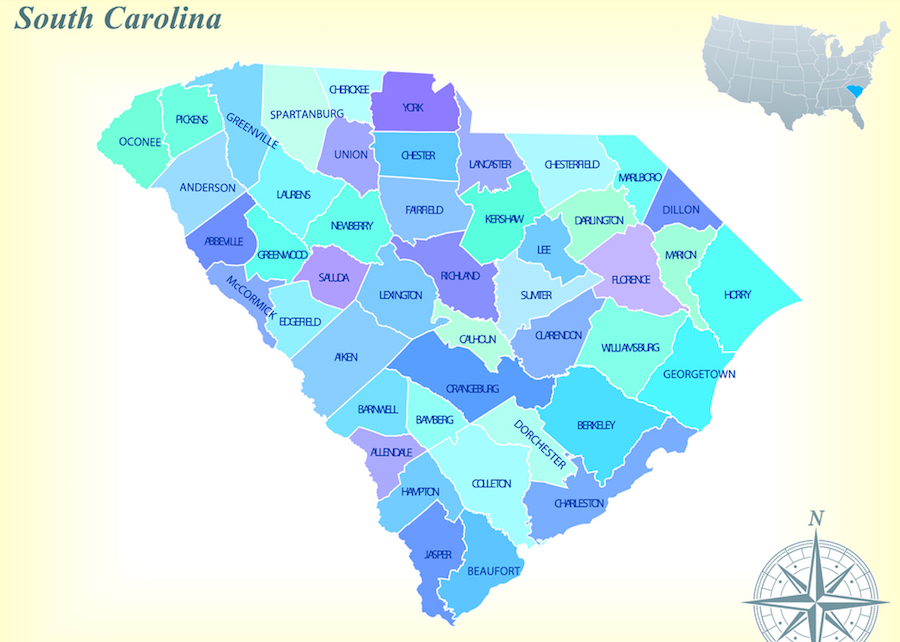
Map of South Carolina showing counties. Click to enlarge.
A Quick Lesson on South Carolina Demographics
At the end of the Civil War, South Carolina had 31 counties. By 1919, we had 46. Fifteen new counties were added in between, many to honor prominent men in South Carolina’s history.
For years, the state ran everything and counties had very limited power. Adding counties essentially meant drawing new lines on the map. New counties were carved out of existing counties: Marion became Marion and Dillon; Charleston became Charleston, Berkeley, and Dorchester; Barnwell became Barnwell, Allendale, and Bamberg; and so on. County populations were slashed as more counties were added, but again, that had no real practical consequences, as the state was mostly in charge.
When counties gained more power after the Home Rule Act was passed in 1975, however, the number of counties – and their smaller sizes – began to matter. Where the state had previously been in charge, suddenly counties were responsible. Many counties found themselves without the ability to raise adequate funds from their low populations to provide the police and emergency services, public schools, infrastructure, parks, libraries, and other services and amenities they were now responsible for. That issue persists for some counties to this day.
Which S.C. Counties Are Growing and Which Are Shrinking?
It appears to be a vicious cycle. As counties are able to provide less to their residents, residents leave for greener pastures, leaving the county with even fewer people to tax and even less money to provide for their remaining residents.
You can see this happening in census numbers. Between 2010 and 2018, 21 of South Carolina’s 46 counties have declined in population: Abbeville, Allendale, Bamberg, Barnwell, Calhoun, Chester, Chesterfield, Clarendon, Colleton, Darlington, Dillon, Fairfield, Hampton, Lee, Marion, Marlboro, McCormick, Orangeburg, Sumter, Union, and Williamsburg.
A further 11 grew more slowly than the U.S. growth rate of 6.0%: Aiken, Cherokee, Edgefield, Florence, Georgetown, Greenwood, Laurens, Newberry, Oconee, Pickens, and Saluda.
Three counties grew faster than the U.S. growth rate of 6.0% but slower than the South Carolina growth rate of 9.9%: Anderson, Kershaw, and Richland.
The remaining 11 counties grew faster than the South Carolina growth rate of 9.9%: Beaufort, Berkeley, Charleston, Dorchester, Greenville, Horry, Jasper, Lancaster, Lexington, Spartanburg, and York.
See the charts at the end of this post for all the numbers.
What This Means for Businesses Moving To South Carolina
Be strategic before selecting a place to open your business.
South Carolina as a whole is a great place to run a business, but some counties are more attractive than others due to available workforce and infrastructure. Counties with a growing population will be more likely to support your business for years to come.
In general, counties on the coast (with the exception of Georgetown) and in the northwest part of the state (which include fast-growing cities Spartanburg, Greenville, and Rock Hill) have been trending upwards in terms of population over the past decade.
Get strategic advice from Mt. Pleasant corporate attorney Gem McDowell
Population is just one factor when it comes to deciding where to open your business in South Carolina. To discuss legal aspects of your business, contact business attorney Gem McDowell of the Gem McDowell Law Group.
Business owners need more than corporate legal services to make their businesses thrive – they need strategic advice. Gem McDowell has over 20 years of experience helping businesses grow in South Carolina. He can advise on a number of topics including complex real estate transactions, where to open a new factory or office, what to do about corporate taxes, and much more.
Contact Gem and his associates at the Mount Pleasant office today by calling (843) 284-1021 or filling out this contact form online.

South Carolina counties that lost population 2010-2018. Click to enlarge.

South Carolina counties that grew at a rate of less than the U.S. growth rate of 6.0%. Click to enlarge.

South Carolina counties that grew faster than U.S. growth rate of 6.0% but slower than S.C. rate of 9.9%. Click to enlarge.

South Carolina counties that grew faster than the S.C. rate of 9.9%. Click to enlarge.

Did You Choose the Wrong Business Type?
Picking what kind of business you’re going to be – “choice of entity” – is one of the first and most important things you do when you start a business. It’s an area where many business owners can get into trouble because they don’t know what they don’t know. Beyond basic issues of personal liability and how many people are in your company, there are subtleties you may miss if you don’t know the law.
Here are some common business types, and why they may be the wrong choice for your business. (If you think you’ve already set up your business as the wrong entity, don’t worry; Gem and his associates can help you.)
Sole proprietors and partnerships
The benefits of sole proprietorship and partnerships
Many businesses default to these business types because they don’t require any formal federal or state paperwork to set up. (You should still look into whether you need licenses and permits, though.) If you start selling baby blankets online and making money, you’re automatically a sole proprietor. If you and your buddies start roasting coffee and selling it, you’re in a partnership. It’s very easy, which is why these are still very common business structures.
What to watch out for
The major drawback – and it’s a big one – of being one of these two types of business entity is that you have no liability protection. Your personal assets are not protected in case your business is sued or goes into debt. That means that you can lose your money, your home, your car, and any other assets you have if the business gets into trouble. For partnerships, you take even more risk, because you’re not just reliable for your own actions and debts you incur, you’re liable for those of your partners, too.
The bottom line
It’s better to choose a different business structure altogether than to accept the risk of putting your personal assets on the line.
Limited liability companies (LLCs)
The benefits of LLCs
The big benefit is liability protection. With an LLC, as long as you maintain a separation between business and personal accounts, you will be (in most cases) protected from being held personally liable for the debts of your business. An LLC is flexible because you can have a single-person LLC or an LLC with multiple people. For taxes, the income (or loss) “passes through” to the owners to include on their personal tax returns.
For all these reasons, the LLC is an ideal business structure for many companies.
What to watch out for
With LLCs, there’s more than meets the eye. Did you know that there are four ways to establish a limited liability company in South Carolina? Most people don’t. And when most people set up the business themselves, they inadvertently set it up as the wrong type of LLC.
An LLC can either be “term” or “at will” and can be “member managed” or “manager managed.” Let’s say you and your friend are in an LLC together and you don’t yet have a buy-sell agreement. If your friend dies, and your LLC is set up as “at will” instead of “term,” you have only a limited time to buy out their portion of the business, or the business dissolves.
Or let’s say you’re in an LLC with your business partner and your LLC is set up as “member managed.” Even if that person owns just 1% of the business, they can go to the bank and take out money in your company’s name, which you’re now on the hook for.
The bottom line
The LLC is a great business structure, but you need to make sure it’s set up as the correct type of LLC. There are four possible types of LLC, and only one is ideal.
Corporations
The benefits of corporations
As a business entity, the corporation is great because it’s robust and can grow easily with capital from investors. Most of the brand name companies you know are corporations. You can choose to be a C-Corp or an S-Corp depending on how you want to be taxed. This is a great choice for a company looking to grow with outside investors and shareholders.
What to watch out for
If you’re a regular corporation, you’ll be required to have a board of directors, hold regular meetings, keep meeting minutes, and have those minutes available to shareholders to review. Failure to do these things can lead to a Plaintiff’s lawyer asking a court to “pierce the corporate veil” when the company is sued. That is, blurring the line between what’s business and what’s personal. In the worst-case scenario, you could be personally liable and find yourself paying off the company’s debts with your own assets.
But you can sidestep these problems entirely by electing to become a “statutory close corporation” by filing with the State of South Carolina. Every corporation in South Carolina is eligible. You get the benefits of being a corporation, but you won’t be required to have a board of directors and hold meetings if you don’t want to.
The bottom line
If you’re already a corporation but your company is not meticulous about holding board meetings and maintaining minutes, look into becoming a statutory close corporation. And even if you are meticulous, it’s just one more layer of protection for you.
Get Help Setting Up Your Business
The majority of companies are not set up in a way that’s optimal for the business owner, says Mount Pleasant business attorney Gem McDowell. If you want to discuss choice of entity for a new or existing business, call Gem and his associates at (843) 284-1021 today. They can help you evaluate your options and choose the entity that’s right for your business.